
The tourist in the way of my photo…is my photo

Updated: Feb 19

The first time I remember it happening was years ago, on the Big Island of Hawaii.
We were at Hawai’i Volcanoes National Park, waiting for night to fall so we could get a good view of a lava lake that had recently bubbled to the surface. I set up my tripod in the viewing area, noticing several other photographers had done the same thing. Everyone was playing nicely. Until darkness closed in.
Suddenly the area was swarmed with tourists intent on shooting the lava pool and oblivious to everything else around them. One tourist stood right in front of my tripod, completely unaware I was behind him. “Excuse me?” I said to him. Nothing. I tapped him on the shoulder. “Excuse me?” He finally turned around, and looked shocked to see a person there. “Oh!” he said. “Sorry!” And walked off, point and shoot camera in hand.
My view was now clear and I thought I was set. But strangely, the photos I took of the lava were exceptionally pedestrian. They showed nothing more than rocks surrounding a glowing pool of orange liquid and orange vapour. Yawn.
That scene played out again and again over the years. I’d be standing in front of an amazing view or subject, ready to take a photo…and some jughead would jump in front of me and spoil the shot, unaware or unconcerned that I was there.
It happened again a few weeks ago, in Porto, Portugal. I was lining up a shot of my wife standing near a fountain…a typical tourist shot (yes, even “serious” photographers take some of those). I had my camera to my eye and was just about to take my shot when BAM a fellow strolled in front of me with his phone and started taking photos.
What did I do? I gritted my teeth, cursed a little under my breath and took the shot anyway. The tourist was now resident on my memory card, though he almost certainly wasn’t aware of what had happened. Awareness, it seemed, was not his strong suit.

I should be clear: I’ve never been against the idea of shooting people.¹ I did a lot of that when I worked for newspapers and it felt quite natural.
But when I decided to pursue photography personally and more seriously, I had some high-minded idea that I wanted to focus only on the natural world. I even built that desire into a rough mission statement: as much as possible, shoot natural scenes untouched or unsullied by the works of man. No wires. No poles. No buildings. No people. Just landscapes or wildlife. The way the world would have looked if humans had never existed.²

I went well out of my way to get these humanity-free photos. I got up early. Stayed up late. Waited patiently for people to move along. Tied myself in knots to get pristine photos.
It hardly ever worked. People still got in the way of my photos. If they didn’t move on quickly, or if I couldn’t encourage them to do so, I threw a tiny internal temper tantrum and often abandoned the shot completely.
That couldn’t go on. My mission statement was going out the window and my blood pressure was getting high. I needed a change.

Experts say one of the best ways to overcome a challenge is to reframe the problem — to look at it from a different perspective. So after being disappointed one too many times, that’s what I did.
I decided that if people chose to get in the way of my shot, whether through ignorance or malice, they were now my shot. They had volunteered to be my models.
What a world of photographic opportunities that opened up!

Tourist sites, attractions and city streets crowded with people were no longer an obstacle to taking photos: they were a portal to making more interesting photos. They were outdoor studios filled with models who would never need special makeup, be paid or sign release forms. In many cases, they made the photos better, adding context and visual interest that would otherwise not be there.
Now, I know what you’re probably thinking: all this guy did was become a street photographer. Because that’s exactly what street photographers do: they go into the streets, find interesting backgrounds or light or texture and shoot candid scenes that include people, usually on film or in black and white. For street photographers, having people in the shot is the whole point. (Of course, if you ask five street photographers to define “street photography” you will get five different answers. I’m not trying to be exhaustive.)³
But becoming a street photographer was not my intention. Not by any stretch of the imagination.
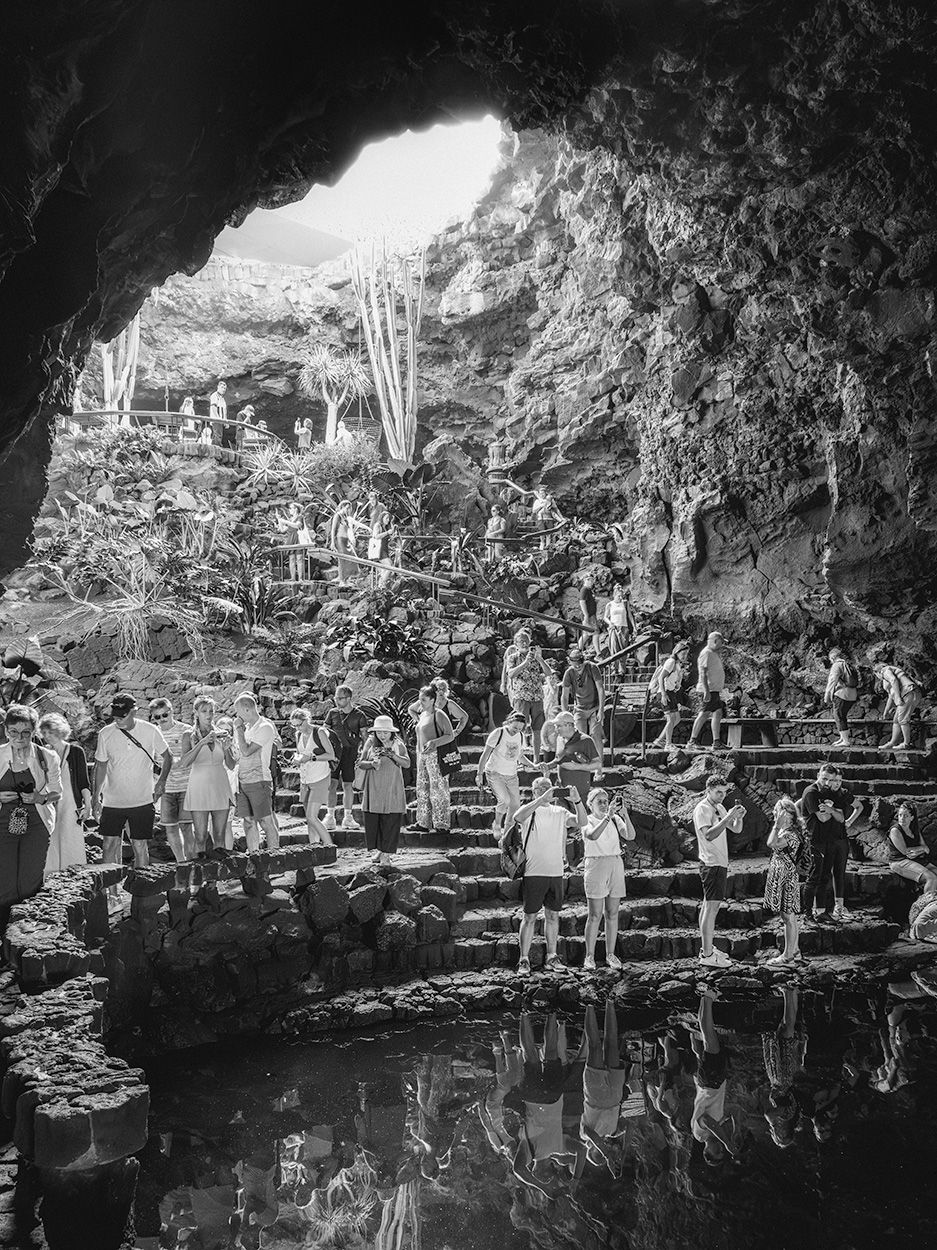
I simply realized that capturing the “reality” of a location often means accepting that the place is infested with people, many of them as intent as me at getting their photo of whatever is interesting or their snapshot of friends and family standing in front of the Designated Interesting Thing™.
So I let it go. If people wandered into my shot, I photographed them. If they weren’t there, I photographed without them.

I’ve learned the photos I take with people in them are often more engaging than the ones I take without them. The world, it seems, is more dynamic with life in it than looking like the abandoned avenues that remain after a neutron bomb detonation.
The photos I take now feel much richer than simple shots of old stone or landscapes. They include all sorts of fascinating vignettes, small slices of life inadvertently captured in the split second I took the photo. A couple arguing. A child tugging on a parent’s pant leg. A row of tourists holding mobile phones aloft to capture their one, unique photo of something photographed thousands of times. Members of a tour group wearing their earpieces and obediently following their sign-carrying leader.

With apologies to Ryan Holiday, the obstacle to my photo turned out to be the way to a more interesting photo.
Today, if I were faced with the crowd of people trying to shoot a lake of lava in Hawai’i, I would probably stand well away from the designed photography area and shoot photos of the photographers themselves. Maybe with the lava lake in the background for context.
Wouldn’t that be a more interesting photo than some lame, orange lake of fire?
Notes:
That sounds wrong, and bad. But I’m sure you understand.
Of course, I did take photos with people in them, mostly friends and family. The key distinction was that those were people I wanted to have in the shot rather than imbeciles who wandered into the shot.
Sean Tucker divides street photographers into two categories: hunters and fishers. Hunters go out looking for interesting situations to photograph on the street while fishers find an interesting location or backdrop and wait for someone to walk into it. I’m not sure if that is an original idea or not, but it is a helpful distinction.


Comments